| Black-and-White Postcards I’d been in Berlin for three days and hadn’t see a single cloud in the sky. Each day was sunny and warm and perfectly summerlike, unusual for late September in Germany. Only the leaves on the trees hinted of a cooler autumn to come, with just the slightest of color changes, from green to gold and yellow and specks of bronze. The Berlin Marathon had just taken place over the weekend, and there was still a festive feel to the city, the streets busy with people in town for the race. They weren’t all Germans. I heard many languages being spoken: Italian, Spanish, and English. It was Monday, and Berlin was getting back to normal. Workers were taking down metal barriers along the race route and dismantling food stalls that had sold bratwurst right off the grill, with steaming kraut and cool cucumber salad, and drink stands that had offered dark German beer and wine across from the Brandenburg Gate, at the marathon finish line. |
It was patrolled by soldiers, some of whom had dogs so ferocious that only women could handle them, as they were
trained to attack men on sight and kill those trying to escape over or under or through the wall to freedom in West
Berlin.
Souvenir stands along the sidewalks where the wall once stood sold black-and-white postcards with scenes from
World War II and the Cold War. From these small pictures, I could see how different it was then, with barbed wire
and rusted steel-beam crosses sunk deep into the flat, barren, grassless ground, just in case any daring East
Berliners tried to break through the wall by car or truck. At these stands, I saw old Russian uniforms and German
Democratic Republic (GDR—East German) soldiers’ hats being sold, along with other remnants of the Communist
army that patrolled the wall around Potsdamer Platz years ago. I wanted to walk and find more evidence of the wall,
but the entire area looked nothing like it had when the postcard pictures were taken. Yet I could feel the ghostly
presence of the Berlin Wall.
trained to attack men on sight and kill those trying to escape over or under or through the wall to freedom in West
Berlin.
Souvenir stands along the sidewalks where the wall once stood sold black-and-white postcards with scenes from
World War II and the Cold War. From these small pictures, I could see how different it was then, with barbed wire
and rusted steel-beam crosses sunk deep into the flat, barren, grassless ground, just in case any daring East
Berliners tried to break through the wall by car or truck. At these stands, I saw old Russian uniforms and German
Democratic Republic (GDR—East German) soldiers’ hats being sold, along with other remnants of the Communist
army that patrolled the wall around Potsdamer Platz years ago. I wanted to walk and find more evidence of the wall,
but the entire area looked nothing like it had when the postcard pictures were taken. Yet I could feel the ghostly
presence of the Berlin Wall.
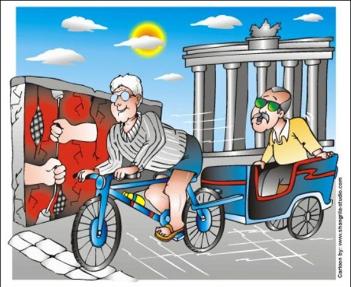
| The Bicycle Man of Berlin |

That day, I arose late and didn’t get a strong, dark coffee
and a croissant from the café across the street from my
hotel, a new Marriott in the Potsdamer Platz section, until
almost noon.
The Potsdamer Platz of today has a modern underground
train station and comprises the central part of Berlin’s
newest towers. Nearby, the all-glass Sony Center and the
Deutsche Bank building both rise prominently above new
hotels and sleek, distinctively modern office buildings of
tinted glass and glimmering metal.
But before the fall of Communism in 1989, Potsdamer Platz
had the misfortune of being situated directly in the path of
the 400-yard-wide no-man’s-land on either side of Ebert
Strasse, from where the new train station is now and north
toward the Brandenburg Gate about two miles away. In the
middle of this deserted area stood the menacing Berlin
Wall, an area that some called the killing zone.
and a croissant from the café across the street from my
hotel, a new Marriott in the Potsdamer Platz section, until
almost noon.
The Potsdamer Platz of today has a modern underground
train station and comprises the central part of Berlin’s
newest towers. Nearby, the all-glass Sony Center and the
Deutsche Bank building both rise prominently above new
hotels and sleek, distinctively modern office buildings of
tinted glass and glimmering metal.
But before the fall of Communism in 1989, Potsdamer Platz
had the misfortune of being situated directly in the path of
the 400-yard-wide no-man’s-land on either side of Ebert
Strasse, from where the new train station is now and north
toward the Brandenburg Gate about two miles away. In the
middle of this deserted area stood the menacing Berlin
Wall, an area that some called the killing zone.
by Michael Domino
Copyright © 2007 by Michael Domino
Denis Proulx / Shangri-La Studio